SYLLABUS
DOUG COBB
 

The Physics of Being Known

BY RITA DEURDULIAN

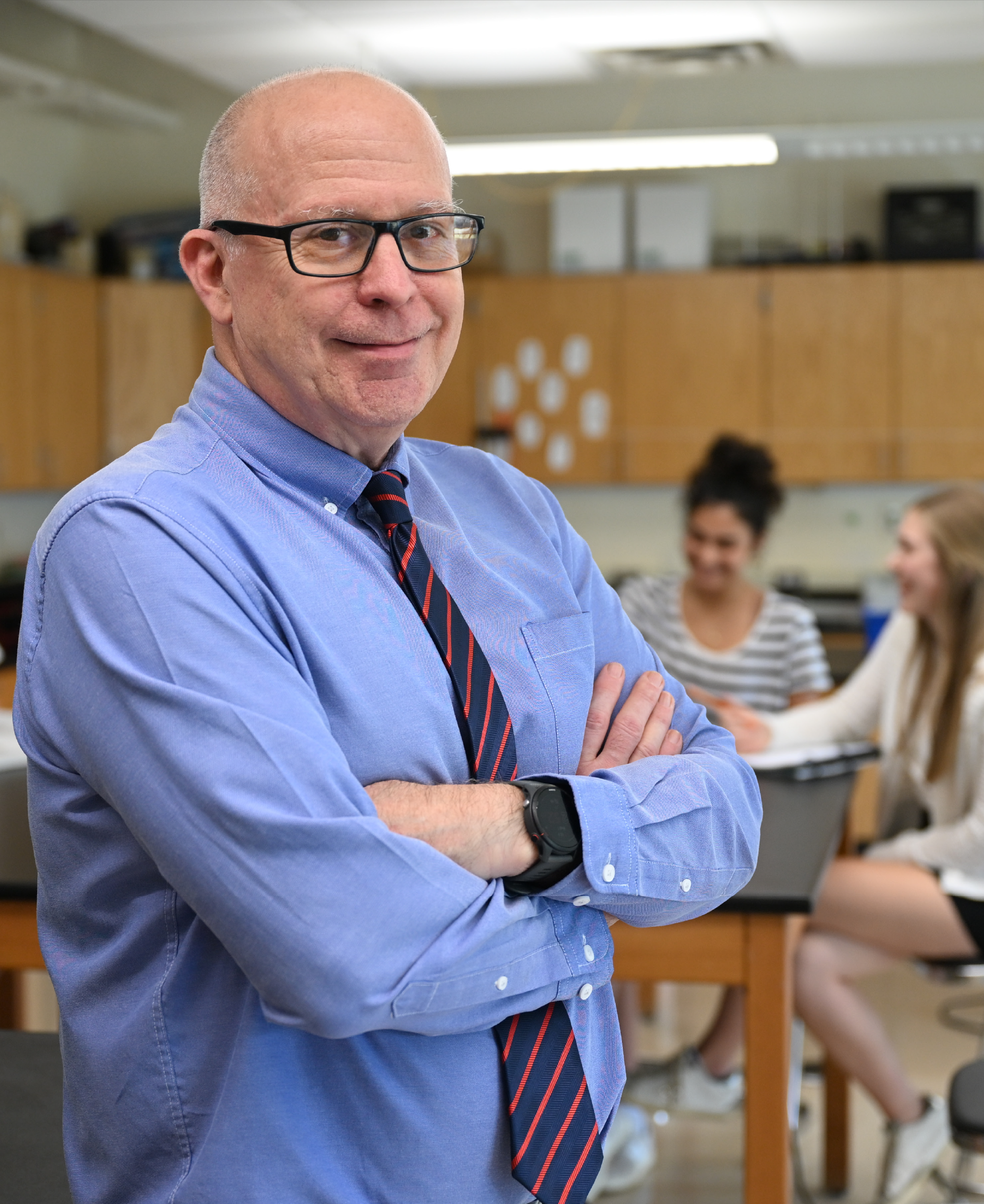
In physics, the observer effect suggests that the mere act of watching a phenomenon inevitably changes it. Doug Cobb, Potomac’s Science Chair and a veteran of the Upper School since 1997, spends his days teaching honors physics students about these laws of the universe. But in his role as an advisor, he practices a different kind of observation—one where the goal isn’t to change the student, but to provide the steady gravitational pull they need to stay on track.

On a typical Thursday morning at Potomac, the hallway outside Doug’s classroom is a blur of energy. But as his advisees stroll into his room for Advisory, the atmospheric pressure changes. “Sometimes the students come in a little harried, a little frantic,” he confides. “But by the last five minutes, the temperature drops. They’ve had a snack, they’ve talked to their friends, and they’ve talked to me. It’s a stress reliever. It has to be.”

A FOUR-YEAR CONSTANT
Many independent schools in the U.S. incorporate advisory programs to provide small-group mentorship, social-emotional support, and academic guidance. These programs typically pair a faculty member with a group of students.

According to Doug, the magic of the Advisory program lies in its longitudinal nature. Unlike schools where advisors are assigned by grade level—a revolving door of mentors for each year of high school—Doug meets a group of around 10 ninth graders and stays with them until Commencement—and beyond in many cases.
“When Potomac shifted to the four-year Advisory model—it was huge,” Doug explains. “You aren’t just a face they see for 10 months. You become a fixture in their lives.”
 
This isn’t just a theory to him. He is still in touch with his very first Advisory group— members of the Class of 2001. Those former students are now in their early forties, yet the bond remains.
 
“There are kids in those groups I never actually taught in a physics lab,” he says. “If I weren’t an advisor, I would have missed them entirely. You realize that a student might struggle in a lab but be an absolute leader in service learning or on the field. You see the whole person.”
 
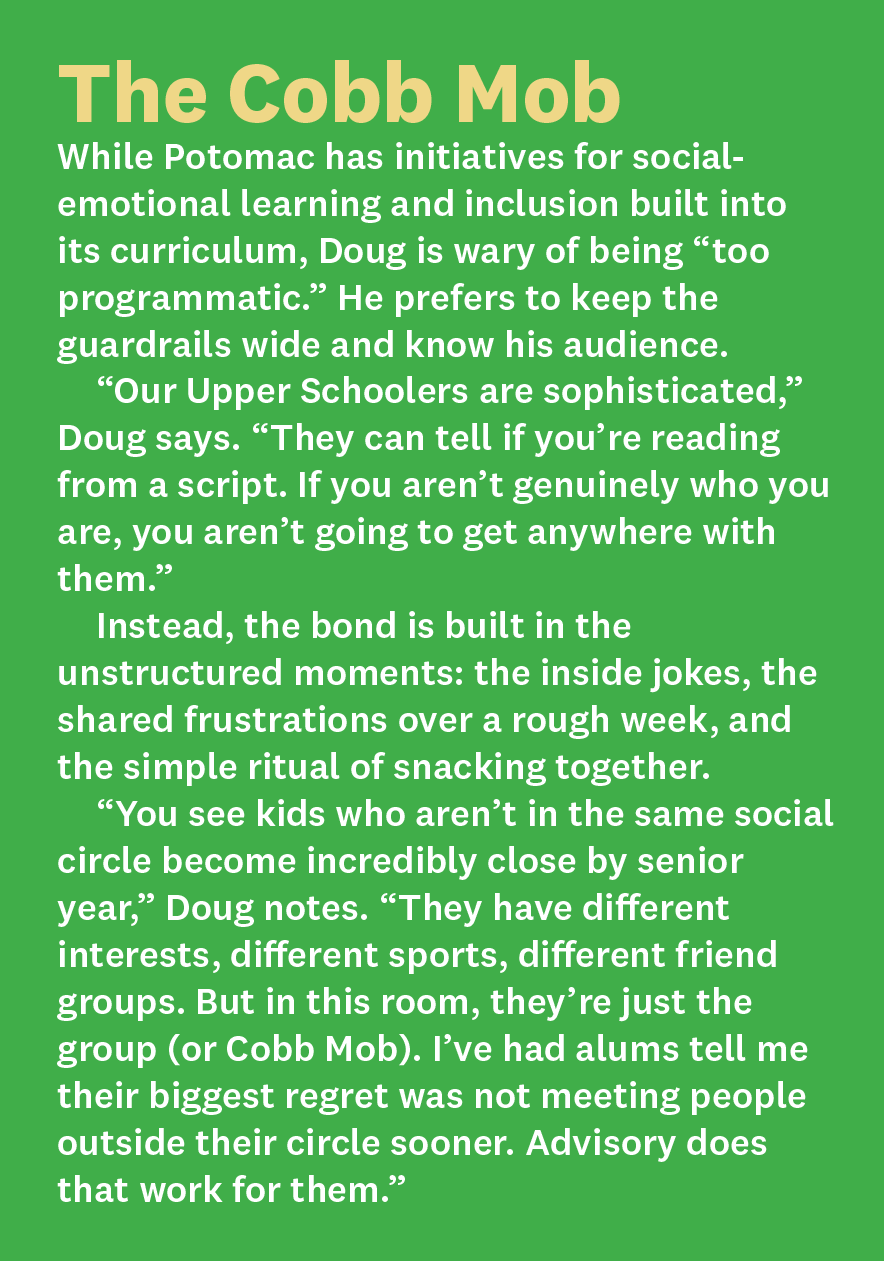
The Cobb Mob
A BALANCE OF SUPPORT AND CHALLENGE
Doug views the school’s mission through the lens of a balance scale: support on one side, challenge on the other. “We want to challenge kids to go further than they think they can,” he says. “But if it’s all challenge, they break down. If it’s all support, they don’t grow.”
 
The Advisory program is the support side of that equation. It’s the safety net that allows the academic rigors of Potomac to exist. As the primary point of contact for parents and a sounding board for other teachers, the advisor acts as a central hub. If a student is failing to turn in homework, Doug doesn’t just see a missing assignment, he knows the context—the stress at home, the injury on the field, a late-night rehearsal.
 
“What’s the value of Potomac beyond the transcript?” he asks. “The kids are going to get the grades. They’re going to build incredible resumes. But the real value is that they feel known. There was an adult who valued them for more than their performance in the classroom.”
 
THE PHYSICS OF CONNECTION
After nearly 30 years, Doug hasn’t taken a break from advising. He’s seen the program evolve, but the core remains: showing up and being real. “Just be yourself,” he says. “The kids want to know us as much as we want to know them.”
 
Just as his current advisees head to their next block, they leave his room a little more grounded than when they entered. In Doug’s world, that’s the most important result of the day. No formula required.
This article appeared in the Spring 2026 issue of The Term.
 

Read this issue

Nature’s Best Photography co-founder Steve Freligh ’71 on the deep impact of the living world
Leigh Ernst Friestedt ’85 is using her on-field intuition to challenge a multibillion-dollar NCAA settlement— and defend the future of Title IX
Josh Stinchcomp ’91 Believes Trust and Innovation Are Helping Journalism Meet the Moment.
Leading Roll: Striking it Big on Your Next Venture

What makes one startup soar while another stalls? Two veteran investors, Damien Petty ’93 and Stefanie Thomas Martin ’03, reveal the traits in a founder who—rather than a startup’s product, profit, and market fit—can make or break a venture.

Read More

Moving Pictures

Davis Guggenheim '79 first broke through with his 2006 film An Inconvenient Truth, which won the Academy Award for Best Documentary Feature, and he has since directed acclaimed works such ...

Read More

Feature: Family Style

Michael Farah ’99 left Wall Street to build a Brooklyn restaurant around the flavors of his mother’s table.

Read More